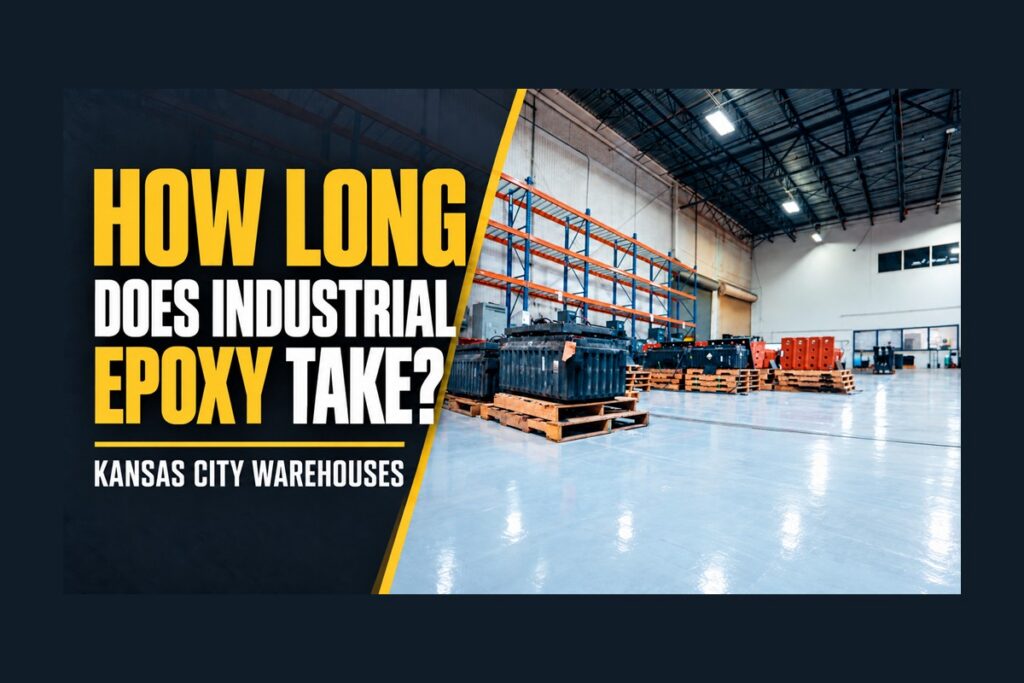


For most warehouse and facility managers, the biggest concern about installing a new industrial epoxy floor isn’t just the price.
It’s downtime . . . ?
- How long will the area be unavailable . . . ?
- When can employees walk on the floor . . . ?
- When can forklifts return . . . ?
- When can production restart . . . ?
And perhaps most importantly:
- Can the flooring project be completed without disrupting the entire operation?
At Advanced 360 Total Floor Care, these are some of the first questions we discuss when evaluating industrial flooring projects throughout the Kansas City metro.
The answer isn’t the same for every warehouse.
The installation schedule depends on the condition of the existing concrete, required repairs, surface preparation, flooring system selected, temperature, cure requirements and how quickly the facility needs the area returned to service.
How Long Does a Warehouse Epoxy Flooring Project Take?
Many industrial epoxy flooring projects require multiple stages rather than simply applying epoxy to concrete.
A typical project may include:
- Removing an existing coating or flooring.
- Preparing the concrete.
- Repairing cracks, spalls and damaged areas.
- Treating concrete joints.
- Addressing moisture conditions when necessary.
- Applying the primer or moisture-control layer.
- Installing the epoxy or resinous flooring system.
- Applying broadcast aggregate or decorative flake when specified.
- Applying grout and/or protective topcoats.
- Allowing the flooring system to cure before reopening the area.
That is why two warehouses with the exact same square footage can have completely different installation schedules.
At Advanced 360 Total Floor Care, we believe the better question is:
- What has to happen to this floor before it can safely return to production?
Surface Preparation Can Determine the Schedule
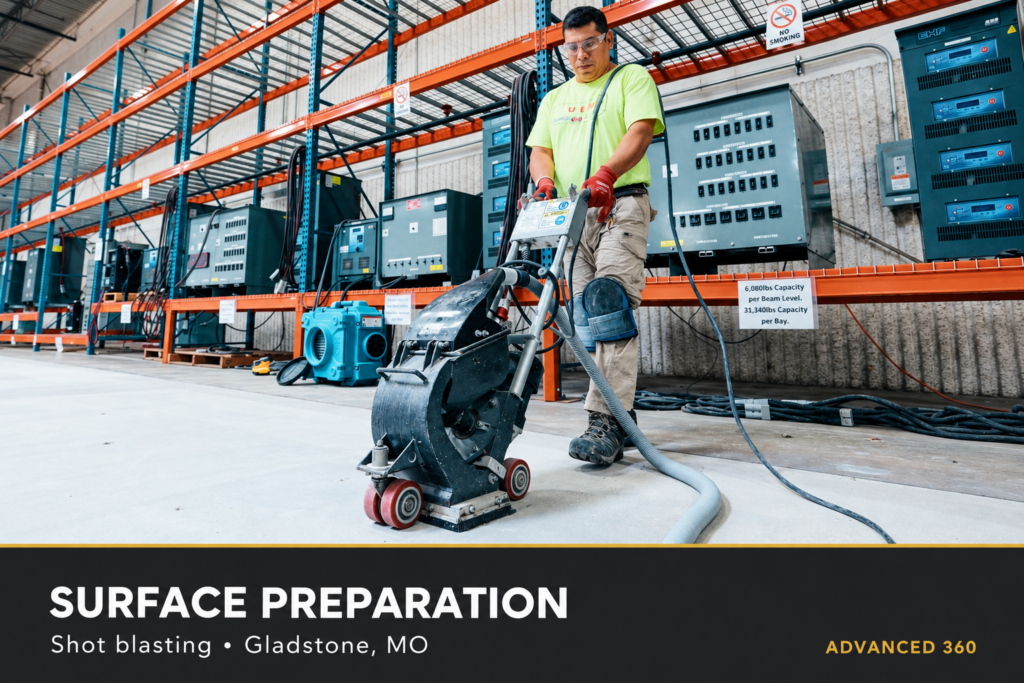
Proper surface preparation is one of the most important parts of an industrial flooring installation.
A coating system is only as reliable as the surface underneath it.
Depending on the existing concrete and flooring system, preparation may involve:
- ✅ Diamond grinding
- ✅ Shot blasting
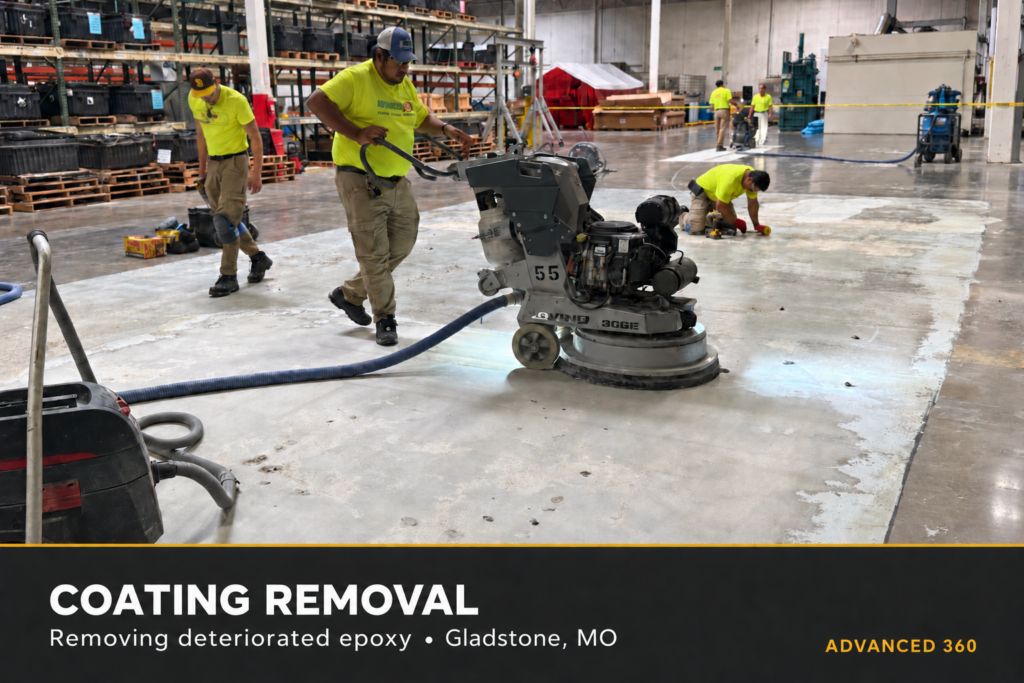
- ✅ Existing coating removal
- ✅ Adhesive removal
- ✅ Cleaning contaminants
- ✅ Crack repair
- ✅ Spall repair
- ✅ Joint treatment
- ✅ Concrete profiling
Skipping preparation to save time can create a much bigger problem later.
If an industrial coating loses adhesion or begins delaminating, the facility may eventually have to shut the area down again, remove the failed system and start over.
For Advanced 360 Total Floor Care, speed matters – but proper preparation comes first.
Existing Epoxy Can Add Significant Time
One of the biggest variables is whether an existing coating must be removed.
Removing a thin coating that is already deteriorating can be very different from removing a well-bonded, high-build resinous flooring system.
This is something facility managers should consider when comparing proposals.
One contractor may quote a shorter schedule because the proposal assumes the existing floor can simply be coated over.
Another may include mechanical removal and proper preparation.
Those aren’t necessarily equivalent scopes of work.
Before Advanced 360 Total Floor Care recommends an installation schedule, we want to understand what is currently on the concrete and what condition it is in.
Concrete Repairs Need to Happen Before the Coating
An epoxy coating alone does not repair deteriorated concrete.
If a warehouse floor has any of these, an evaluation should be completed before installing the new flooring system:
- ❗ Broken concrete
- ❗ Spalling
- ❗ Cracks
- ❗ Damaged joint edges
- ❗ Failed patches
- ❗ Potholes
- ❗ Deteriorated construction joints
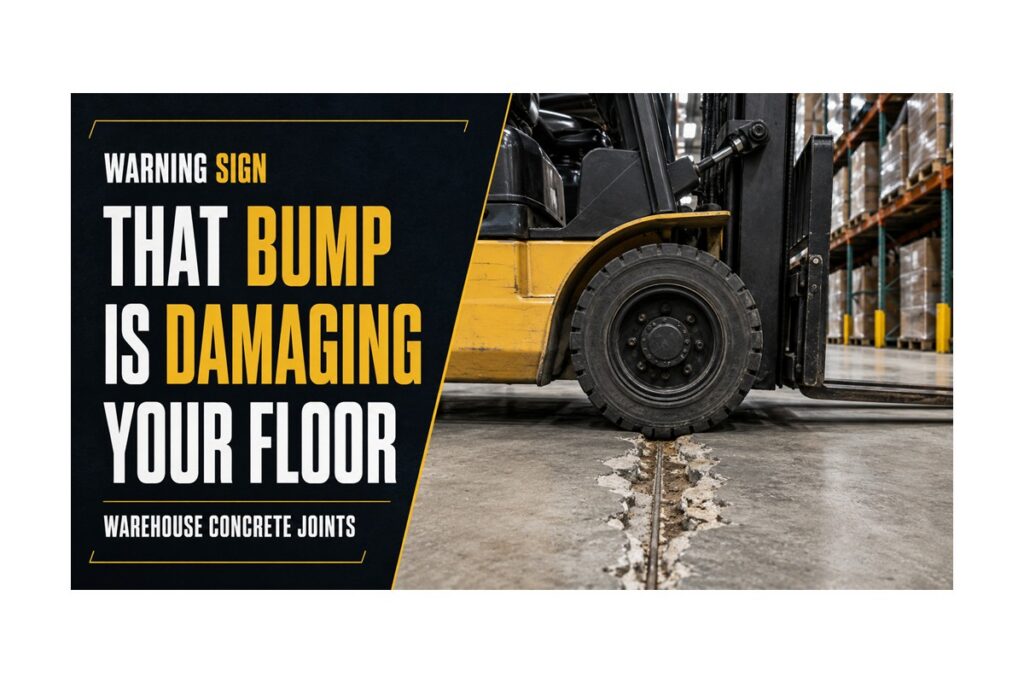
This is particularly important in warehouses where forklifts repeatedly cross damaged concrete joints.
Putting a beautiful coating over a failing substrate doesn’t eliminate the underlying problem.
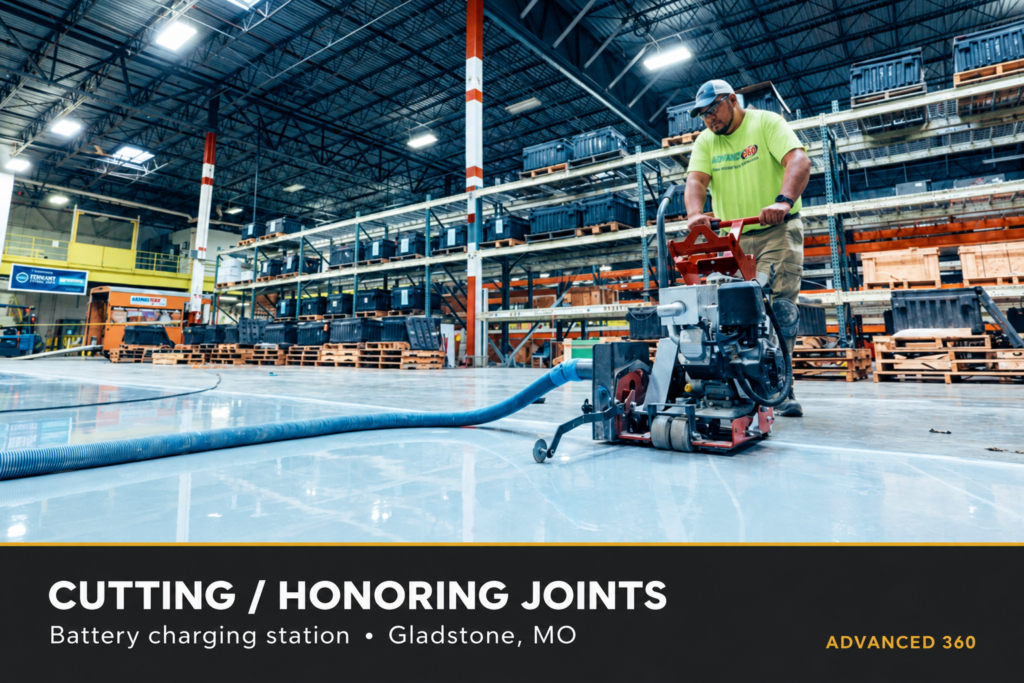
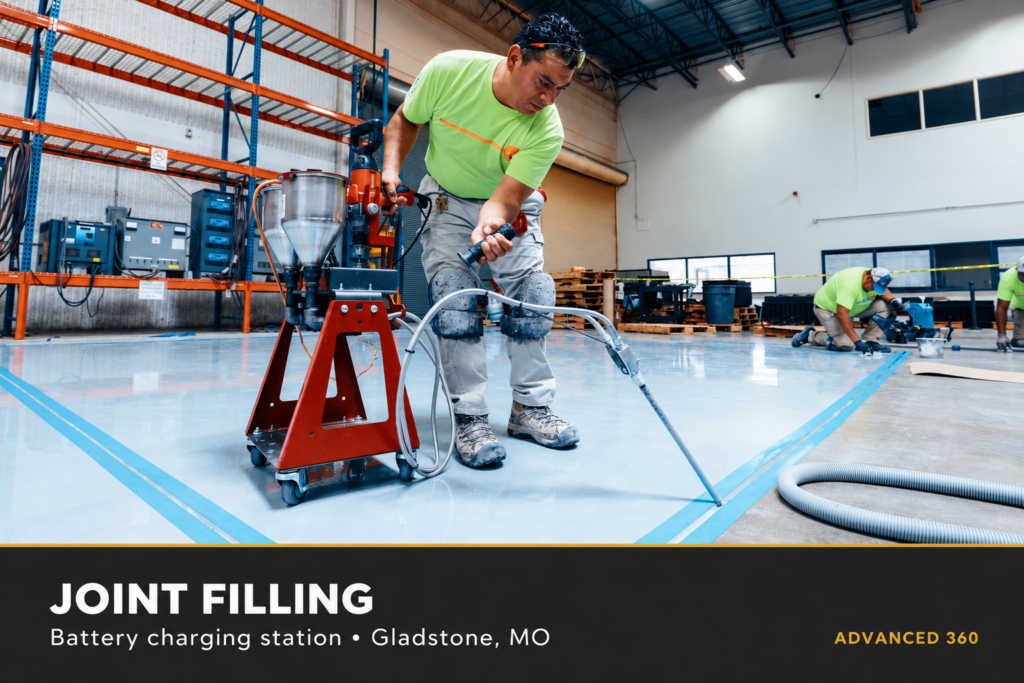
Advanced 360 Total Floor Care provides industrial concrete repair and warehouse concrete joint repair in the Kansas City metro as part of our broader industrial flooring capabilities.
➜ See how Warehouse Concrete Floor Repair Solutions can address damaged warehouse floors while minimizing disruption to your operations.
➜ Learn how professional Warehouse Joint Filler Installation protects concrete joint edges and reduces repeated forklift impact.
Moisture Can Change the Flooring System
Another factor that can affect both the installation process and system selection is moisture.
This is particularly important with slabs on grade.
A concrete surface can appear dry while moisture conditions within the slab tell a different story.
When moisture is a concern, Advanced 360 Total Floor Care may recommend further evaluation before installing the coating.
Depending on the conditions and selected flooring system, a moisture-vapor-control system may need to become part of the flooring assembly.
This is why we don’t believe in choosing an epoxy system based only on square footage.
✓ The environment determines the system.
Not Every Industrial Floor Should Use the Same Epoxy System
When someone calls us and says:
- “I need an epoxy floor.”
Our next question isn’t simply:
- “How many square feet?”
We need to understand what happens on that floor every day.
For example:
Warehouse and Distribution Areas
- These environments may experience constant forklift and pallet-jack traffic, turning, braking and hard-wheel impact.
Manufacturing Facilities
- Manufacturing floors may experience oils, chemicals, equipment loads, abrasion and concentrated traffic.
Food-Processing Areas
- Frequent washdowns, hot water, chemicals and thermal cycling can require a different resinous flooring chemistry than a typical warehouse.
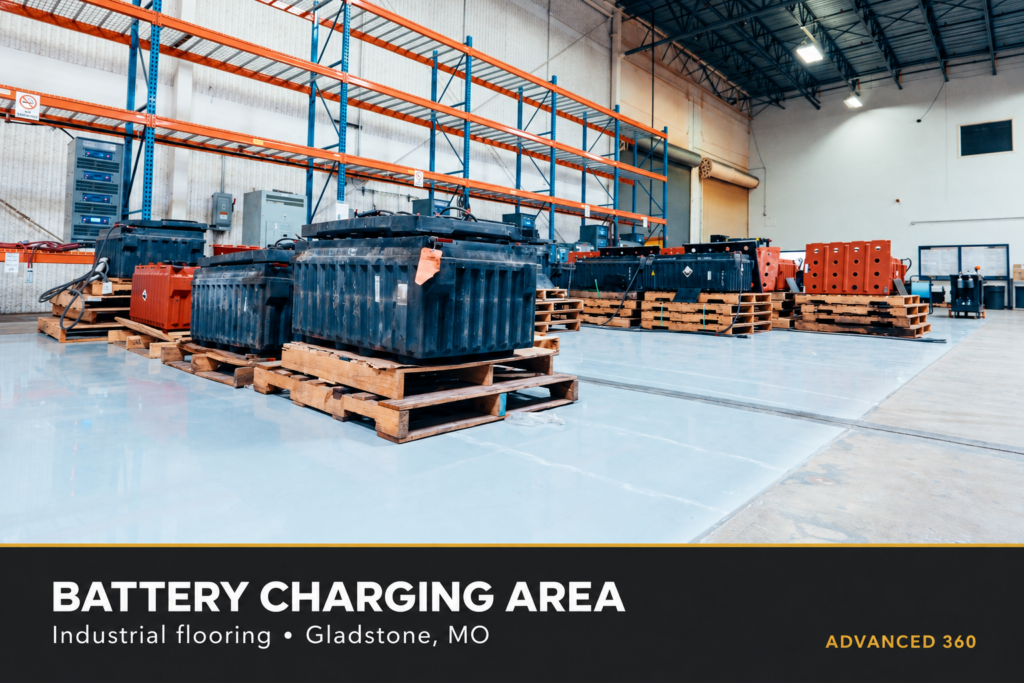
Battery-Charging Areas
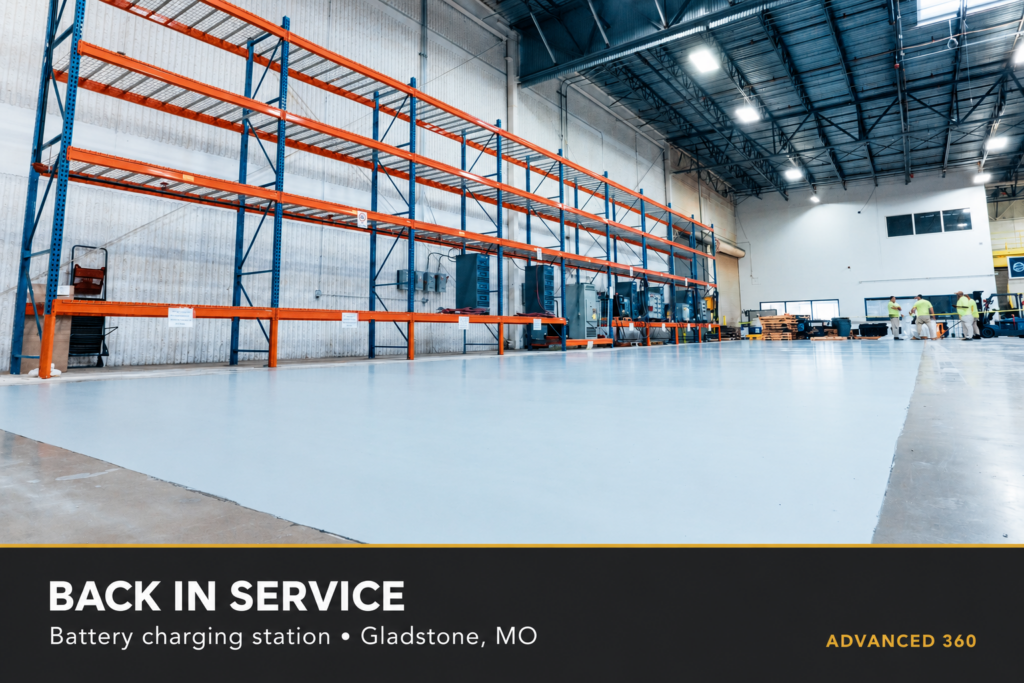
- Battery electrolyte and chemical exposure may require specialized chemical-resistant flooring.
Mechanical and Utility Rooms
- These areas can have entirely different exposure and traffic requirements from the production floor outside them.
Advanced 360 Total Floor Care works with epoxy, urethane cement, moisture-vapor-control systems, protective urethane and other industrial resinous flooring technologies.
The objective isn’t to sell the same system everywhere.
It’s to select a system appropriate for the environment.
➜ Explore Industrial Floor Care Solutions in Kansas City designed for chemical exposure, heavy traffic, and demanding facility conditions.
How Long Before You Can Walk on an Epoxy Floor?
There is no responsible universal answer.
Cure and return-to-service times vary depending on:
🧪 Product chemistry
🌡️ Temperature
💧 Humidity
📏 Coating thickness
🔢 Number of coats
🧱 Concrete conditions
📋 Manufacturer requirements
🚶 Type of traffic
Foot traffic, rolling carts and loaded forklifts also represent very different service conditions.
A floor that can tolerate light foot traffic isn’t automatically ready for a loaded forklift making sharp turns.
Advanced 360 Total Floor Care follows the requirements of the flooring system being installed rather than promising an arbitrary return-to-service time before evaluating the project.
When Can Forklifts Go Back on the Floor?
This is one of the most important questions for warehouse managers.
Heavy forklift traffic can place considerably more stress on a new floor than employees walking across it.
Before returning forklifts to service, factors such as the coating system, cure conditions and manufacturer’s requirements should be considered.
Rushing this stage can compromise a flooring investment before the system has had an opportunity to develop the properties it was designed to provide.
That’s why we ask facility managers:
- “When does this area absolutely have to be back in production?”
Knowing that deadline early allows us to evaluate the flooring system and project phasing around the facility’s operational needs.
Can Advanced 360 Total Floor Care Work Around Warehouse Operations?
Often, yes.
Instead of approaching every project as one large shutdown, we can evaluate whether the work can be divided into manageable phases.
Depending on the facility, that might mean:
- Working one aisle at a time
- Dividing the warehouse into sections
- Scheduling work around production
- Weekend installation
- Coordinating around shutdown periods
- Prioritizing critical traffic areas
- Using faster-return systems when appropriate
The exact strategy depends on the facility.
Our objective is not simply to install a floor.
It’s to understand how the project affects your operation.
The Cheapest Flooring System Can Become Expensive When Downtime Is Included
Facility managers should consider more than installation price.
Suppose one flooring option costs less but requires a longer shutdown.
Another system costs more but allows production to resume sooner.
The second system may actually represent the better business decision.
The same applies to preparation.
Reducing preparation may lower the initial project price, but if the flooring system fails prematurely, the facility may pay for:
- ❌ Removal
- ❌ Repairs
- ❌ Replacement flooring
- ❌ Another shutdown
- ❌ Additional labor
- ❌ Operational disruption
The true cost of industrial flooring is therefore not simply: Price per square foot.
It equals: Installation + expected performance + downtime + risk of future disruption.
Questions Kansas City Facility Managers Should Ask Before an Epoxy Project
- How will you prepare the concrete?
- Does the existing coating need to be removed?
- How will cracks and damaged concrete be repaired?
- What will happen with the concrete joints?
- Have moisture conditions been considered?
- Why are you recommending this particular flooring system?
- What chemicals will the system be exposed to?
- How will forklift traffic affect the system?
- How long before foot traffic can return?
- How long before forklifts can return?
- Can the project be phased around our operation?
- What warranty is provided?
These questions help move the conversation away from simply comparing square-foot prices.
Industrial Epoxy Flooring in the Kansas City Metro
Advanced 360 Total Floor Care provides industrial flooring solutions for warehouses, manufacturing plants, distribution facilities and other commercial and industrial properties throughout the Kansas City metro.
Our capabilities include:
- ✅ Industrial epoxy flooring
- ✅ High-build epoxy systems
- ✅ Urethane cement flooring
- ✅ Chemical-resistant flooring
- ✅ Moisture-vapor-control systems
- ✅ Concrete repair
- ✅ Concrete joint repair and joint filler
- ✅ Existing coating removal
- ✅ Polished concrete
- ✅ Industrial safety striping
We serve facilities throughout the Kansas City metro, including Kansas City, MO, Kansas City, KS, Lenexa, Overland Park, Olathe, Shawnee and surrounding communities.
Performance. Safety. Reliability.
At Advanced 360 Total Floor Care, we believe an industrial flooring contractor should understand more than coatings.
We need to understand your operation.
- What travels across the floor?
- What chemicals reach it?
- How often is it washed?
- What’s happening with the concrete?
- What has failed before?
- And when does the area need to be back in production?
Those answers help determine the appropriate preparation, repair process and flooring system.
Our Pain-Free Service Promise means facility managers shouldn’t have to take on a second job babysitting the flooring contractor.
Frequently Asked Questions
How long does industrial epoxy flooring take to install?
- It depends on the existing floor, preparation requirements, repairs, selected coating system, number of coats, environmental conditions and required return-to-service time. A site assessment provides a much more reliable schedule than estimating from square footage alone.
Can you install epoxy flooring without shutting down the entire warehouse?
- Depending on the facility and flooring system, projects can sometimes be phased by aisle, section, department or production schedule to reduce operational disruption.
Can forklifts drive on epoxy flooring?
- Industrial resinous flooring systems can be designed for forklift environments, but system selection, concrete preparation, coating thickness, joints and cure requirements all matter.
Does old epoxy have to be removed first?
- Not necessarily in every situation. The existing coating’s condition, adhesion and compatibility need to be evaluated before determining whether removal is necessary.
Should damaged concrete joints be repaired before epoxy installation?
- Damaged joints and deteriorated joint edges should be evaluated before coating. Simply covering damaged concrete with epoxy does not correct the underlying deterioration.
Does concrete moisture matter before installing epoxy?
- Moisture conditions can affect resinous flooring performance and may influence preparation and system selection.
Schedule an Industrial Floor Assessment
If you’re planning an epoxy flooring project for a warehouse, manufacturing plant or industrial facility in the Kansas City metro, Advanced 360 Total Floor Care can evaluate the existing floor, discuss your operational requirements and help determine an appropriate flooring system and project schedule.
Advanced 360 Total Floor Care | Kansas City Industrial Flooring Specialists
➜ Call 913-322-6200 to schedule your assessment.

Dana writes about commercial cleaning, healthcare environmental services, and professional floor care for Kansas City facilities. Through Advanced 360 Total Floor Care and Sani-SAFE Kansas City, Dana shares real-world guidance on facility maintenance, infection prevention, floor preservation, inspection readiness, and creating cleaner, safer environments.